Pricing
How much does it cost to build a custom web app in 2026?
Published Updated Lefty Software LLC
How much does it cost to build a custom web app in 2026? Most agencies answer that question with a shamanic "it depends" and an invitation to book a call, which tells you nothing. Here is the honest version instead: a focused, first-version web app built by an experienced US developer or small studio has landed, in my experience, somewhere between $15,000 and $75,000 — roughly 150 to 500 hours of work at the $75–150 hourly range I use when estimating US-based work. Those two numbers are my own working assumptions for a first version, not a market survey; multiply hours by rate and you have the order of magnitude. Everything else in this post is about predicting those two numbers for your idea.
The three numbers that set the price
Strip away the sales process and a custom web app quote is just three numbers: the rate, the hours, and how strict your definition of "done" is. No rate band is universal, so treat the ones below as the working assumptions behind every estimate in this post — an illustrative 2026 picture, not a survey:
- Offshore agencies: roughly $25–75/hour. Cheapest per hour, highest coordination cost per feature, and timezones you will feel in every review cycle.
- Nearshore (Latin America for US clients): roughly $50–100/hour. Overlapping hours with US business time, mid-range pricing.
- US small studios and solo developers: roughly $75–150/hour. The most expensive hour, and usually the fewest hours per feature, because the person scoping the work is the person writing it.
Hours depend on scope. In my experience a focused internal tool — one team, a handful of screens, no public signups — often lands at 80–150 hours. A small customer-facing product with accounts, payments, and email flows is commonly 200–500 hours for a first version. Anything that touches legacy data migration or a tangle of third-party integrations moves up from there.
Then there is the sneaky third number: what "done" means. "Working prototype" and "product I can hand to paying customers" can describe the same feature list and differ by 2x in hours. Decide which one you are buying before you compare quotes, because vendors will otherwise assume whichever definition makes their bid look better.
A worked example: a small scheduling SaaS
Abstract numbers don't help much, so here is a concrete scope. I built CourtWiz, a scheduling platform for racquet-sports groups: accounts, players, groups, venues, and lineups; an RSVP flow that ends the group-chat chaos of organizing weekly games; and a polished onboarding flow for new accounts. That is a real product with real users — exactly the kind of build behind my web app development service, and the size of build where the math above applies.
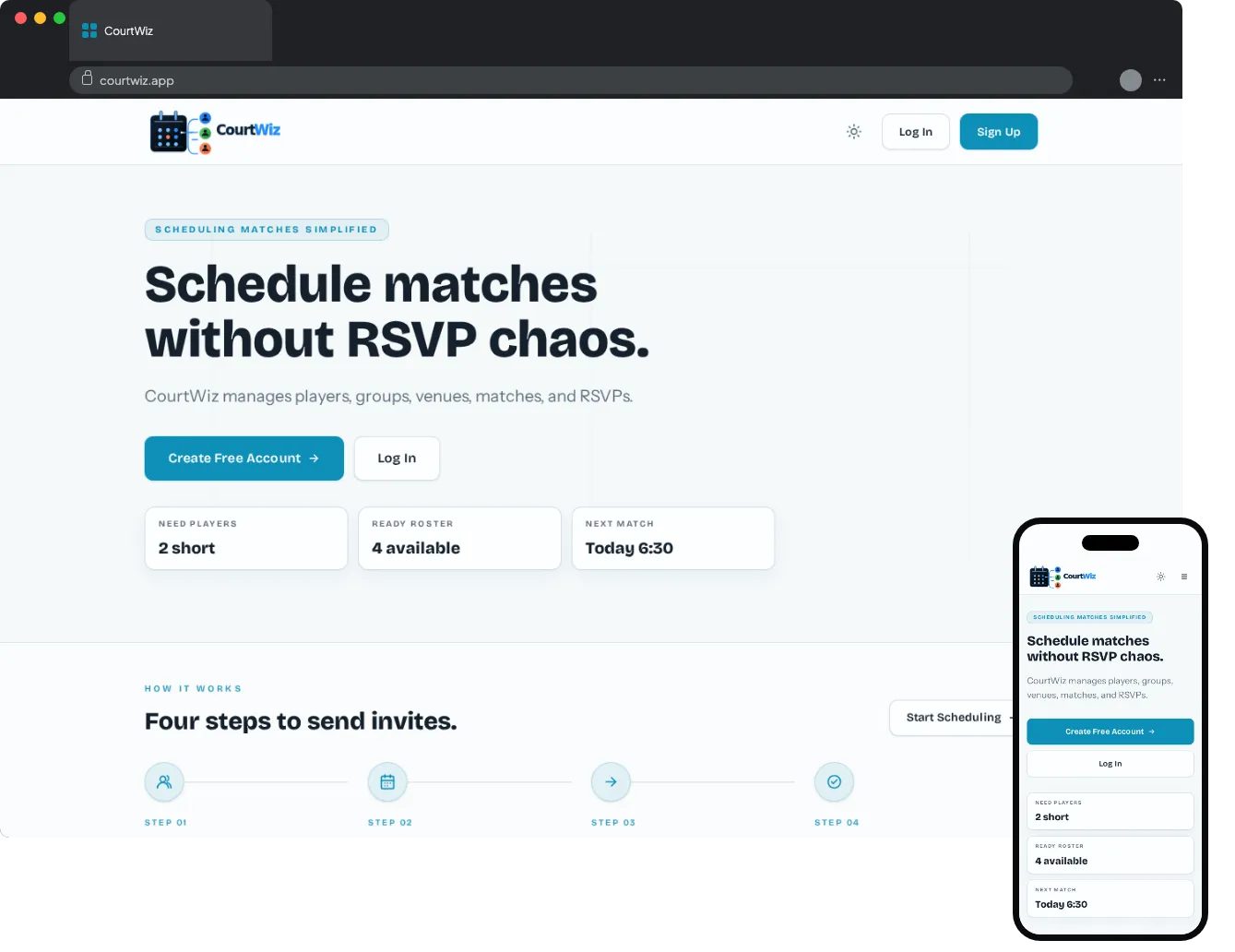
For a scope like that, here is roughly where the hours go on a 250-hour build:
- Core product logic — the scheduling, RSVP, and grouping rules that make the product yours: about 30%.
- Accounts, sessions, and roles: 10–15%. Nobody sees this work; everybody misses it when it's wrong.
- Interface and polish — responsive layouts, empty states, loading states, accessibility: about 25%.
- Email and integrations — transactional email, invites, calendar exports: about 15%.
- Testing, deployment, analytics, and the long tail of small things that make it launchable: the rest.
Worked through the same way, that 250-hour build costs about $25,000 at the US small-studio rate above, before hosting and third-party services; run the same hours at the offshore band and the arithmetic lands near $8,000–15,000. The risk you are underwriting with the difference is coordination, not competence.
What pushes the cost up (and what doesn't)
A few scope decisions reliably add hours:
- Third-party integrations. Payments, accounting systems, ERPs, legacy databases. Every integration is a negotiation with someone else's API and error handling.
- Deep permissions. "Admins, members, and guests" is cheap. "Every record has per-user visibility rules with delegated access" is a project within the project.
- Compliance regimes. HIPAA, SOC 2 readiness, and their cousins add process, not just code.
- Bespoke visual design. A clean, consistent utility interface is fast to build. A unique brand system with custom illustration and motion is design hours on top.
- Migrating old data. Importing real, messy data from a spreadsheet or a legacy system always takes longer than the demo with clean CSVs.
Just as useful is what should not move the number: a custom admin panel when an off-the-shelf one would do, microservices for a product with forty users, or a hand-rolled authentication system. Good developers talk you out of spending money there. That conversation is worth more than a discount.
Fixed price or hourly?
New projects are fixed-price. I agree a written scope and quote with you before development starts, so the initial build has a defined cost. Changes and maintenance can be provided at an agreed hourly rate. Work outside the original scope is discussed before it starts, so you can decide whether to proceed.
Two warnings about price, whichever model you pick. First, a quote far below every competitor is not a bargain; it is missing scope or missing experience, and you will find out which around week three. Second, change is normal — decide up front that any scope change gets a short written estimate before the work starts, and you will never fear an invoice you didn't expect.
The costs after launch
The build is not the end of the spend, and any honest breakdown says so. For planning, budget a rough $10–100 per month across hosting, database, transactional email, and monitoring for a small production app — more once real traffic arrives, but rarely scarily so. My website projects include 30 days of support for defects and questions after the website goes live. Beyond that window, maintenance can be provided at an agreed hourly rate. New features and other changes can also be hourly. My ongoing monitoring service is available if purchased separately; it is not included automatically with the build. Software is a pet, not a photograph. The vendors who tell you otherwise are the ones you'll be re-hiring to fix neglected software later.
What different budgets actually buy
Since "it depends" is useless without anchors, here is an illustrative calculation of what different first-version budgets buy at the rates above. Treat the boundaries as soft — an integration-heavy idea can stretch any of these — but the tiers hold up across projects:
- Around $10,000: a validated concept, not a product. One core workflow, simple authentication, a clean utility interface, enough structure to put in front of real users and learn from them.
- Around $25,000: the focused MVP from the worked example above — proper accounts and roles, the core workflow done thoroughly, transactional email. That figure covers the build itself: hosting and third-party services are billed on top, and monitoring is available if purchased separately.
- Around $50,000 and up: multiple user types with distinct permissions, third-party integrations, a real visual design pass, and the operational edges — bulk actions, exports, audit trails — that separate a demo from a business.
One deliberate omission from these tiers: marketing sites, which shouldn't cost anything like a web app. And note what the tiers argue for — a $10,000 build that earns traction and grows into a $25,000 second version is a far healthier path than a $50,000 launch that assumes traction it hasn't earned yet.
Getting a number you can trust
Whatever you do, insist on a written scope before a price — one page describing what will exist, what is excluded, and what "done" means. It is the single document that prevents most project disputes, and if a vendor won't write one, that tells you something. If you want to see how I run that process end to end, I wrote up exactly what to expect when hiring a solo developer.
Want a real number for your idea?
Tell me what you're trying to build. I'll reply with a written scope and a fixed price — not a sales call.
Start a project