StringBench: everything a stringing business needs, in one place
A business management platform for racquet stringing professionals — customers, rackets, half-reel string inventory, and a QR-coded label for every job, built by Lefty Software for a working stringer.
The chaos before: job details on paper, string stock in someone's head, and rackets that all look alike.
A craft with bookkeeping glued on
A working stringer's regulars each bring their own racket and their own preferences — tension, string, gauge — details that used to live in a notebook or a spreadsheet nobody trusted. String inventory has its own arithmetic: string arrives in packs and reels, gets used in halves, and every hybrid job complicates the count. And every finished racket needs a label that says exactly whose it is, what went on it, and when.
StringBench was built for a working stringer, from the ground up, to put all of that in one place. I designed and built the complete platform: the data model, the interface, and the printed label on the finished racket.
What was built
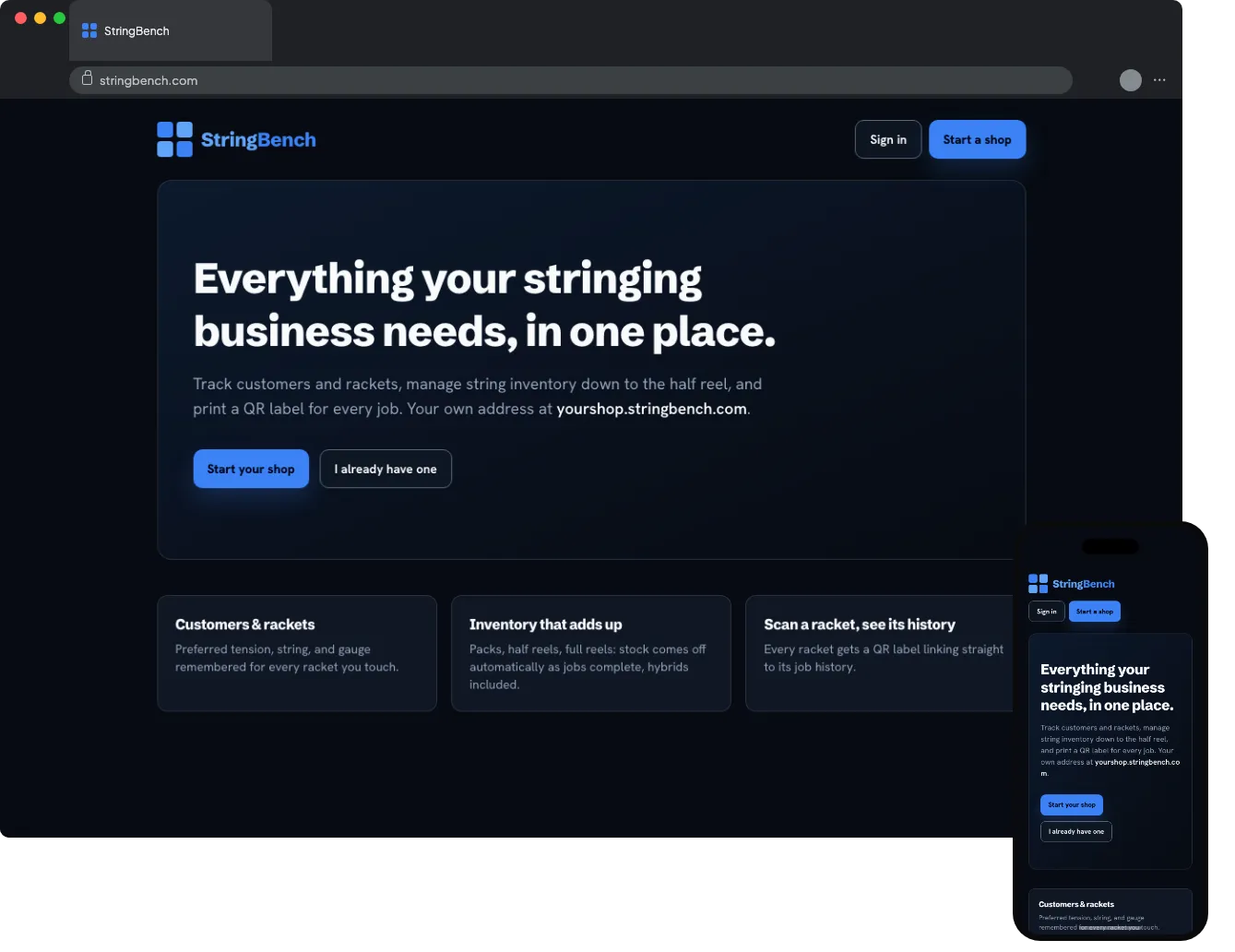
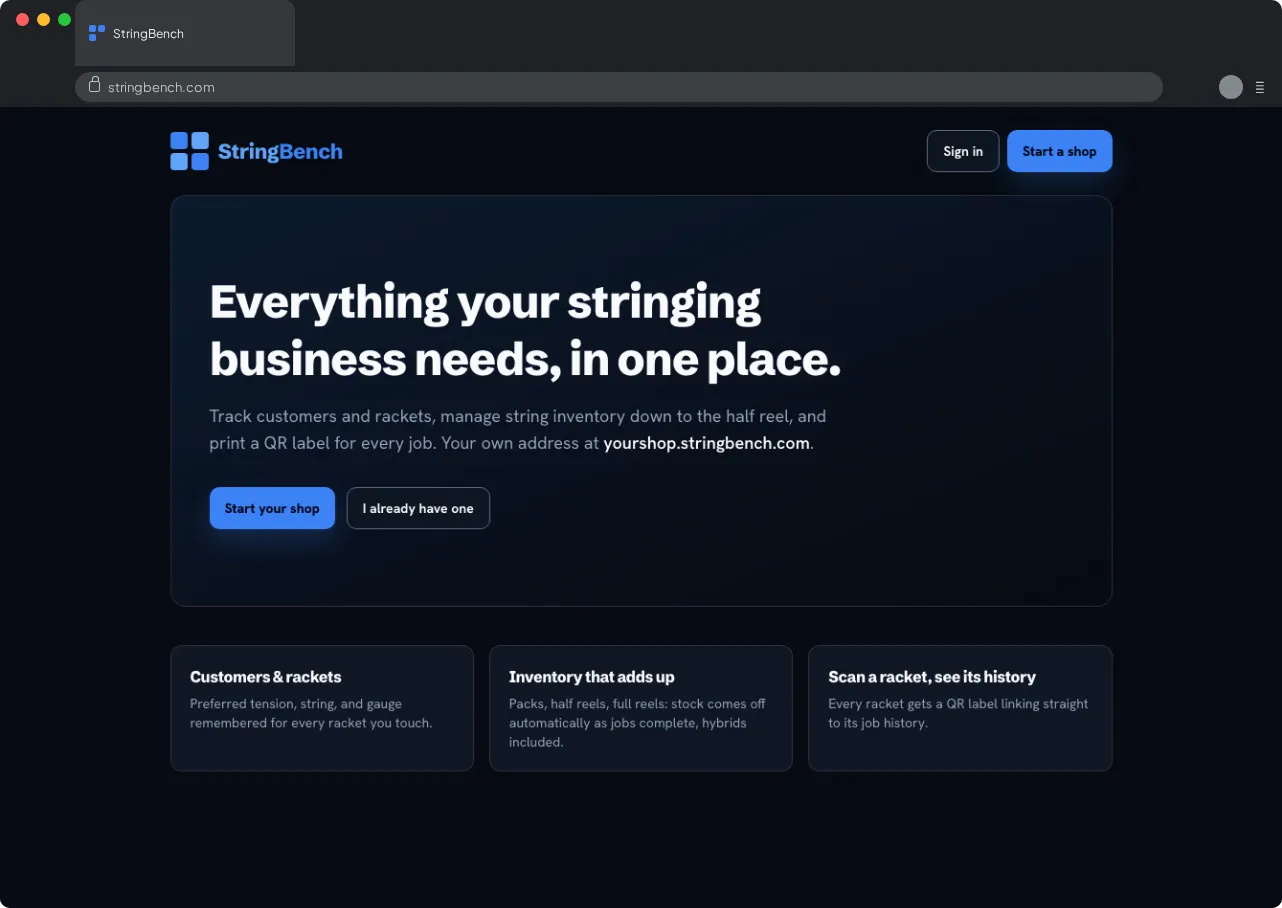
StringBench is a live product at stringbench.com, where each shop runs under its own yourshop.stringbench.com address. Four features do the heavy lifting:
- Customers and rackets, remembered: preferred tension, string, and gauge stay with each racket, so the fourth restring is as easy as the first
- Inventory that adds up: packs, half reels, and full reels tracked precisely, with stock coming off automatically as jobs complete, hybrids included
- A QR label for every job: scanning a racket's label opens its full job history
- A shop of one's own: every stringer signs in under a personal subdomain, not a shared login
Under the hood
StringBench is server-rendered Go with templ templates, enhanced with htmx: job boards, racket histories, and inventory counts update as fragment swaps, with no single-page framework in the build. Tailwind CSS styles the interface. MongoDB stores shops, customers, rackets, and jobs as documents — a good match for a domain where every shop inventories differently. The platform ships as a single self-contained binary that multi-tenant shops share.
See it in action
Where it landed
StringBench runs in production with support for shops using their own subdomains. The outcomes it exists for are structural: job details no longer depend on memory, inventory counts itself as work completes, and any racket's history is one scan away. A tool that began as one stringer's system now runs as a hosted product other shops can sign up for.
This case study describes the platform's capabilities, not customer growth or revenue: a multi-shop product at stringbench.com, designed, built, and shipped by Lefty Software end to end.
Running a business on notebooks and spreadsheets?
StringBench shows what a focused business platform looks like when it is built for the people who use it. Tell me what your tool should do.